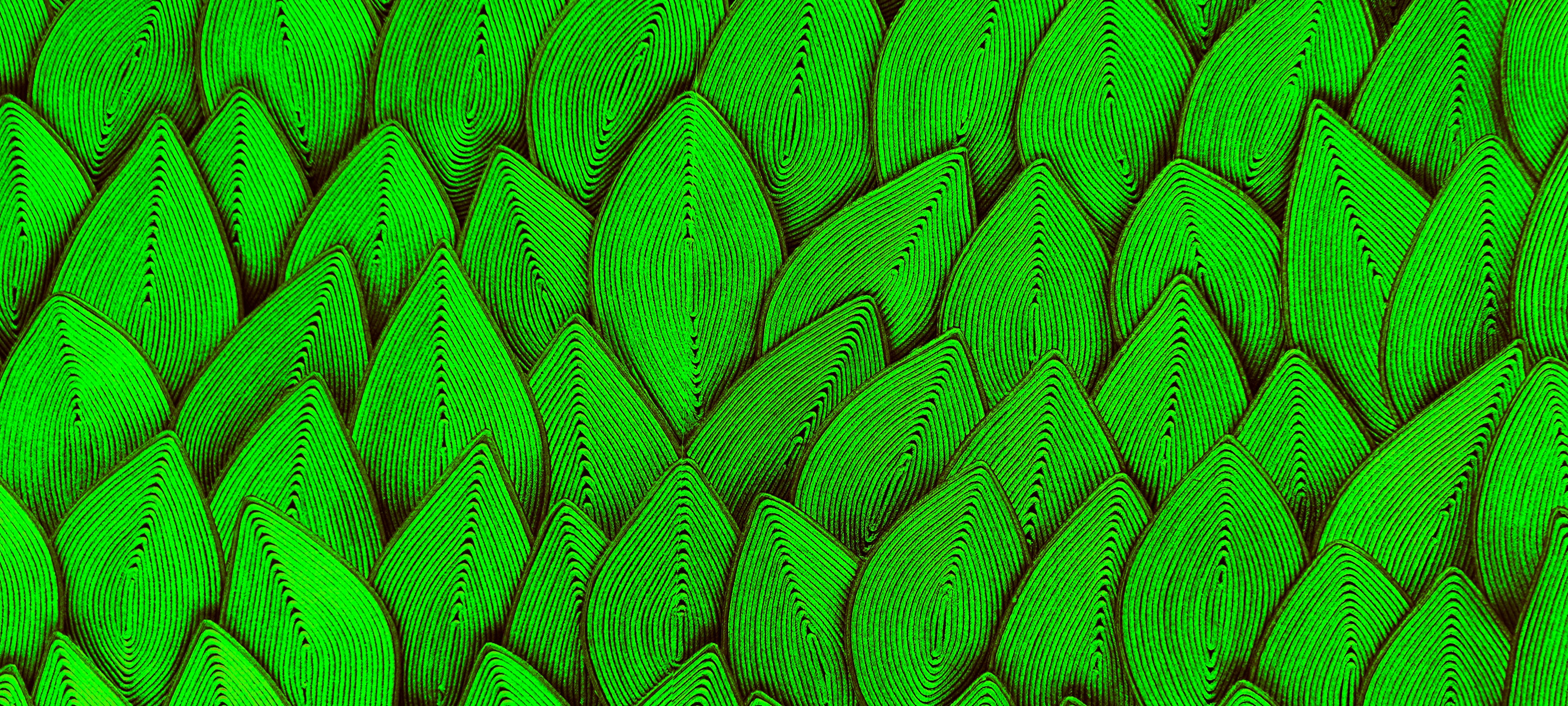
L’opera si presenta come una superficie compatta e ipnotica, composta da forme ripetute che ricordano foglie, squame o impronte organiche. Il verde, saturo e dominante, non è un colore naturale ma una dichiarazione: invade lo spazio visivo con una forza quasi artificiale, trasformando la trama in un pattern pulsante. Le linee concentriche all’interno di ogni forma suggeriscono crescita, stratificazione, tempo che si deposita.
La ripetizione non genera monotonia, ma ritmo. Ogni elemento è simile all’altro, eppure mai identico: leggere variazioni di orientamento e densità creano un movimento continuo, come un campo che vibra sotto lo sguardo. L’insieme oscilla tra decorazione e ossessione, tra ordine sistematico e vitalità organica.
L’opera dialoga con l’arte contemporanea che indaga il confine tra naturale e artificiale, tra ciò che cresce spontaneamente e ciò che viene costruito per accumulo. È una visione che può essere letta sia come paesaggio astratto sia come ingrandimento microscopico, lasciando lo spettatore sospeso tra macro e micro.
Note concettuali
Per l’autore, questa immagine rappresenta la resistenza silenziosa della ripetizione. Ogni forma è un’unità autonoma, ma solo insieme alle altre acquista senso e forza. Il verde diventa simbolo di persistenza, di vita che continua anche quando è compressa, organizzata, quasi costretta in uno schema.
L’opera riflette sull’idea di identità collettiva: essere parte di un sistema senza perdere completamente la propria traccia individuale. È un archivio visivo di presenze minime che, sommate, costruiscono un organismo più grande. In questo senso, Campo di Resistenza non parla di immobilità, ma di una crescita continua e testarda, che avviene per accumulo e ripetizione.
Resistence Field
Artwork sheet · Code: VC-015-2026 · VC Series
Main data
Title: Resistence Field
Artist: Aston F. Deane
Year: 2026
Medium: original digital artwork – photographic manipulation
Output: print on collector’s choice of size and material
The work presents itself as a compact and hypnotic surface, composed of repetitive shapes reminiscent of leaves, scales, or organic imprints. The saturated and dominant green is not a natural color but a statement: it invades the visual space with an almost artificial force, transforming the texture into a pulsating pattern. The concentric lines within each shape suggest growth, stratification, and the accumulation of time.
Repetition does not generate monotony, but rhythm. Each element is similar to the next, yet never identical: slight variations in orientation and density create a continuous movement, like a field vibrating before the gaze. The whole oscillates between decoration and obsession, between systematic order and organic vitality.
The work engages with contemporary art, which explores the boundary between natural and artificial, between that which grows spontaneously and that which is constructed through accumulation. It is a vision that can be read both as an abstract landscape and as a microscopic enlargement, leaving the viewer suspended between macro and micro.
Conceptual notes
For the author, this image represents the silent resistance of repetition. Each shape is an autonomous unit, but only when combined with others does it acquire meaning and strength. Green becomes a symbol of persistence, of life that continues even when compressed, organized, almost forced into a pattern.
The work reflects on the idea of collective identity: being part of a system without completely losing one's individual identity. It is a visual archive of minimal presences that, when added together, build a larger organism. In this sense, Resistence Field is not about immobility, but about continuous and stubborn growth, which occurs through accumulation and repetition.